
Gardening Zones in Canada
If you garden in Canada, you’ve probably memorized your Zone. Maybe you’ve even celebrated a recent upgrade; several cities across the country have moved a half-zone or more to the warmer side in the newest plant hardiness maps. But what does your gardening zone actually tell you? And how should you use it when choosing plants?
Whether you’re a beginner planting your first perennials or a seasoned gardener pushing the limits tender shrubs like bigleaf hydrangea in a warm Zone 4 corner, understanding hardiness zones is the foundation of smart Canadian gardening.
Canada’s Plant Hardiness Zones Criteria
Canada doesn’t use the U.S. system. We developed our own, which is more detailed, more complex and tailored to our wildly varied geography.
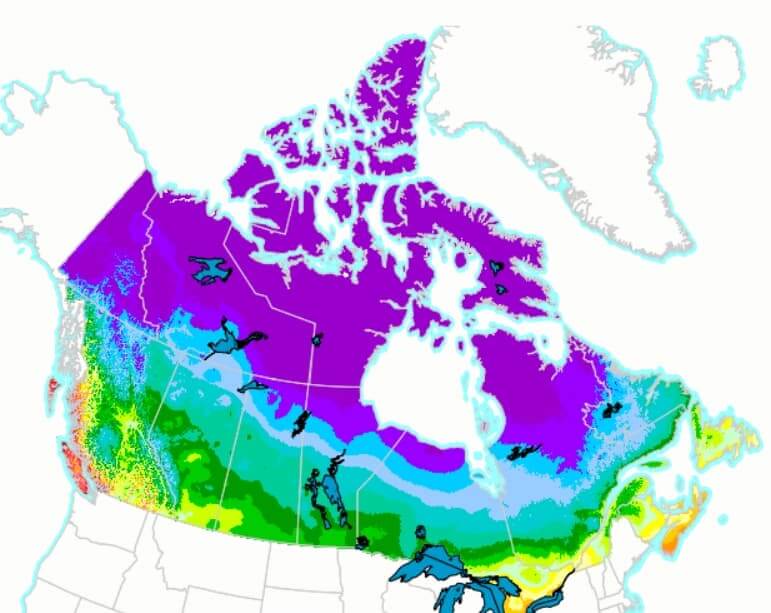
The Canadian Plant Hardiness Zones were originally developed in the 1960s by Agriculture Canada, then updated in 2000, and most recently refreshed by Natural Resources Canada (NRCan) in 2024. Unlike the USDA system, which uses only the average annual minimum temperature, the Canadian system blends seven climate variables:
- Minimum winter temperature
- Maximum summer temperature
- Length of the frost-free period
- Amount of rainfall
- Snow cover
- Wind exposure
- Elevation
This multi-factor model makes the Canadian system particularly helpful in a country where two places may hit the same winter minimum temperature, but that doesn’t mean they’re equal: the Prairies battle dry winds and, in Calgary, unreliable snow, while Newfoundland’s gardens endure fierce maritime winds, heavy wet snow, and very slow spring warm-ups.
What changed in the newest map?
NRCan’s latest analysis uses 30 years of climate data, from 1991 to 2020. It shows a gradual warming trend across the country. Victoria is the most extreme example, jumping from 7a to 9b, and much of the West Coast went up half to a full zone. Southern Ontario experienced the same. Cities in the Maritimes, Quebec and on the Prairies stayed the same or went up half a zone.
Check the rating for your municipality here.
USDA Hardiness Zones
Knowing your Canadian zone is not enough. The USDA zone is the number you will come across most often on plant tags when you are shopping. Even some Canadian seed catalogues and packages use the USDA zones. You should know this, too.
Often you can guess at your USDA zone by subtracting one from your Canadian zone, but that is not always accurate.
In my case, my Canadian zone in Winnipeg is 3b. If you use the conventional method, you get USDA zone 2b, but Proven Winner’s calculates it as 4a.
Here is where you can look for your USDA zone.
Microclimates: The Zone Within Your Zone
Every yard is its own ecosystem. You might live in Zone 3, but parts of your garden behave like Zone 4… or Zone 2.
Warm microclimates include areas next to south-facing foundation walls, particularly these made of stone or bricks. Areas sheltered by fences or evergreens also tend to be less wind-swept. And raised beds warm up faster in spring.
You’ll find lower spots, where cold air pools, to be cooler microclimates, along with north-facing walls and exposed locations. Areas that stay shady, where the snow melts last in spring, are bad places for more tender plants.
What Hardiness Zones are Good For
Hardiness zones are best at determining whether a tree will survive winters in your area. They are also useful when choosing perennials.
Your zone has nothing to do with what annuals, including most vegetables, you can grow.
Zones don’t predict sudden polar vortex events, extreme chinooks, freeze–thaw cycles, or unusually wet winters.
A plant hardy on paper might still fail in a very cold winter with drying winds and little snow. Conversely, a plant rated one zone warmer may survive if tucked into a sheltered microclimate.
In fact, out of zone plants may survive for several years until you get a terrible cold snap. (And this is the heartbreak of gardeners who push the envelope.)